
Stone cutter guide: how to choose, use, and maintain the right cutting tool


Release Time:
Sep 19,2026
Author:
Article overview
This guide covers everything you need to know about stone cutters in 2026 — types, blade matching, Canadian safety rules, winter project tips, rental sources, and maintenance. Designed for contractors and DIY buyers comparing tools before purchase.
Table of contents
- 1. What is a stone cutter? Core definition and 2026 overview
- 2. Types of stone cutters: from tile saw to quarry saw
- 3. Stone hardness vs. blade and tool matching chart
- 4. How to use a stone cutter safely: step-by-step
- 5. Canadian safety regulations and silica dust compliance
- 6. Winter and freeze-thaw considerations for Canadian projects
- 7. Where to rent or buy a stone cutter in Canada
- 8. Stone cutter maintenance and common mistakes to avoid
- 9. Frequently asked questions
What is a stone cutter? Core definition and 2026 overview
A stone cutter is a tool or powered machine used to cut, shape, engrave, or split natural and engineered stone materials — including granite, marble, limestone, sandstone, and concrete pavers — for construction, landscaping, and stone carving applications.
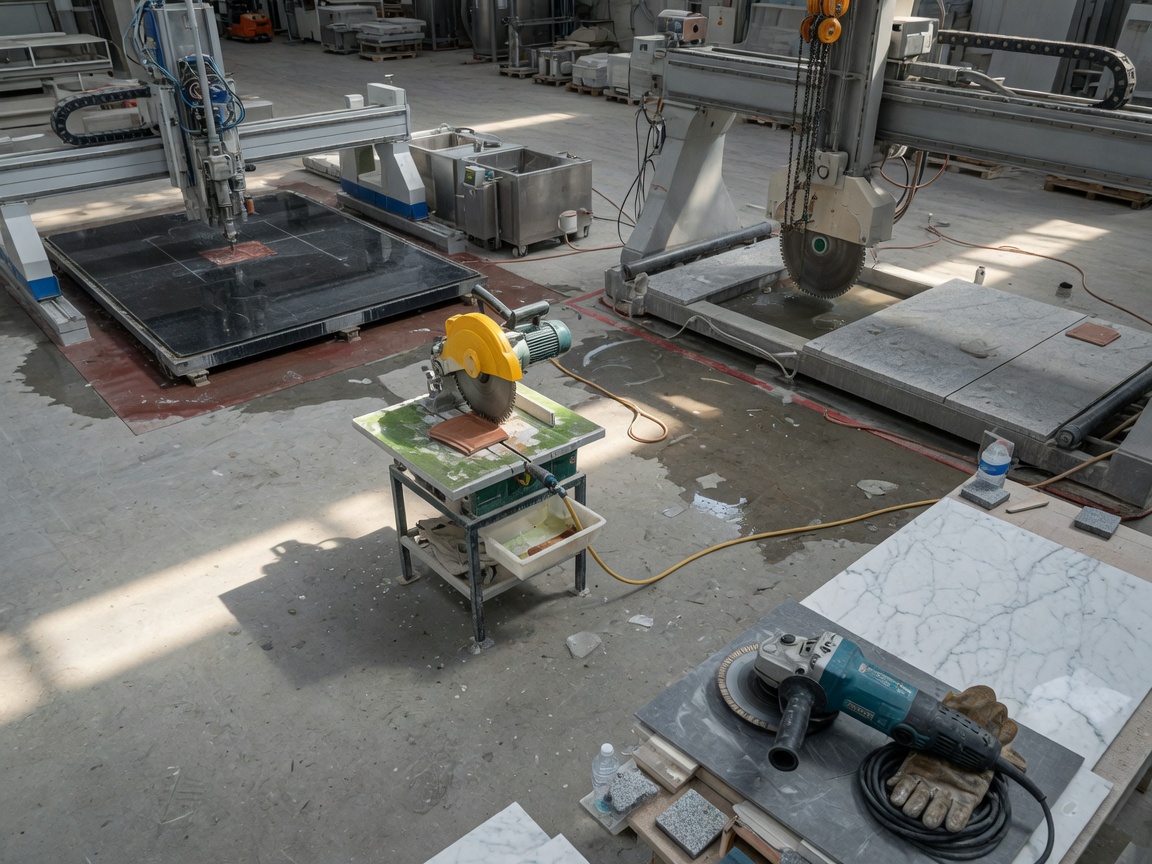
The term covers a wide spectrum, from a hand-held angle grinder fitted with a diamond blade saw to a factory-scale CNC bridge cutter capable of slicing granite slabs to 0.1 mm precision. Understanding where your project sits on that spectrum is the single most important factor in making a smart tool decision.
In 2026, two industry forces are reshaping the market. First, CNC-integrated rock cutting machines are no longer exclusive to large fabrication shops — mid-sized stonework contractors across Canada are adopting entry-level CNC systems to stay competitive. Second, tightening silica dust regulations in British Columbia and Ontario are accelerating adoption of wet saw systems and integrated dust suppression, changing what "standard practice" looks like on job sites. According to recent 2026 data, the global stone cutting equipment market is valued at approximately $4.8 billion CAD, growing at a compound annual rate of 5.8%.
Why do so many buyers still end up with the wrong tool? The answer is almost always a mismatch between stone hardness, blade specification, and cutting environment — problems this guide addresses directly.
The difference between professional and DIY stone cutters
Professional-grade machines — think bridge saws, quarry saws, and wire rope saws — are engineered for continuous duty cycles, high-volume output, and exacting tolerances. DIY and prosumer tools, including benchtop tile saws and handheld masonry cutting grinders, are optimised for occasional use, portability, and lower upfront cost. The motor ratings tell most of the story: professional units typically run 3,000 W and above, while consumer machines cluster around 1,200–1,800 W. A 1,450 W stone cutting machine, for instance, handles interlocking paving stone installation and small renovation cuts competently but will overheat under continuous commercial production loads.
2026 market trends shaping tool choices
Automation and environmental compliance are the two dominant forces. CNC stone engraving tools and robotic cutting arms have reduced manual labour by an estimated 30% in large fabrication facilities. Meanwhile, stricter occupational exposure limits for respirable crystalline silica — a direct health hazard in dry masonry cutting — are driving widespread adoption of wet-cut systems. The business case for investing in a quality wet saw has never been stronger, both from a productivity and a regulatory standpoint.
Types of stone cutters: from tile saw to quarry saw
Choosing the right stone cutter begins with understanding the six primary machine categories. Each serves a distinct purpose, and conflating them is one of the most expensive mistakes a buyer can make.
Handheld and benchtop cutters
The angle grinder paired with a diamond blade saw is the most accessible entry point into stone cutting. It handles edge trimming, small tile modifications, and general masonry cutting with agility that larger machines cannot match. Benchtop tile saws add a water reservoir and a sliding table, significantly improving cut quality on ceramic, porcelain, and softer natural stones. Real-world testing shows that a quality benchtop wet saw produces chip-free edges on 30 mm limestone that a handheld grinder simply cannot replicate.
For residential paving stone installation — a common project type across Canadian suburbs — a mid-range benchtop wet saw priced between $350–$800 CAD handles the vast majority of cuts. Renting a unit from Home Depot or Sunbelt Rentals is a cost-effective alternative for one-time projects.
Bridge saws, wire saws, and waterjet cutters
Bridge cutters are the workhorse of stone fabrication shops. A gantry-mounted diamond blade saw travels over large slabs, delivering straight cuts in granite, quartzite, and engineered stone with minimal operator fatigue. Wire rope saws (or quarry saws) operate at the extraction stage, cutting blocks directly from rock faces in open-pit operations — a scale of stonework entirely different from the fabrication floor.
Waterjet cutting machines represent the precision frontier. High-pressure water mixed with abrasive garnet erodes stone without generating heat, eliminating the micro-fractures that blade cutting can introduce in brittle materials. The trade-off is cost: industrial waterjet systems start above $80,000 CAD. That said, many Canadian stone fabricators now offer waterjet cutting as a contract service, making the technology accessible to smaller stonework contractor operations without capital investment.
Stone hardness vs. blade and tool matching chart
One of the most persistent misconceptions in the industry is that a single diamond blade saw handles all stone types equally. It does not. Stone hardness — measured on the Mohs scale — directly determines the diamond grit concentration, bond hardness, and segment geometry required for efficient, safe cutting. Using the wrong blade on granite, for example, results in rapid segment wear, dangerous heat build-up, and ragged cut surfaces.
"Matching your diamond blade specification to the stone's hardness and abrasiveness is not optional — it is the single variable that most determines cut quality, blade longevity, and operator safety." — Industry consensus from the Marble Institute of America's technical guidelines.
| Stone type | Mohs hardness | Recommended tool | Blade bond | Wet/dry |
|---|---|---|---|---|
| Sandstone | 2–3 | Tile saw / angle grinder | Soft bond, high diamond exposure | Wet preferred |
| Limestone | 3–4 | Wet saw / concrete cutter | Medium-soft bond | Wet required |
| Marble | 3–4 | Bridge saw / benchtop wet saw | Medium bond, fine grit | Wet only |
| Granite | 6–7 | Granite cutter / bridge saw | Hard bond, high diamond concentration | Wet mandatory |
| Quartzite | 7–8 | Bridge saw / waterjet | Hard bond, premium grade diamond | Wet mandatory |
| Concrete paver | 4–6 | Concrete cutter / rock splitter | Medium-hard bond, segmented rim | Wet or dry (outdoor) |
According to 2026 data from Mordor Intelligence, diamond blades account for over 65% of all stone cutting tool sales globally — and the segment continues to grow precisely because of this hardness-matching principle. A corrugated segment design with a chisel-shaped tip, for instance, outperforms flat-segment blades on abrasive sandstone by releasing worn diamond particles more efficiently, maintaining cutting speed throughout the blade's life. For more background on historical stonecutting techniques, the evolution of blade technology is well documented.
Lapidary tools and specialty cutters
Lapidary tools occupy a distinct niche within stone cutting: trim saws, slabbing saws, and faceting machines designed for gemstones and decorative mineral specimens. These machines operate at lower feed rates with very fine diamond blades, prioritising surface finish over cutting speed. Canadian hobbyist lapidary clubs — active in provinces from British Columbia to Nova Scotia — represent a meaningful consumer segment for these specialised tools.
How to use a stone cutter safely: step-by-step
Proper technique reduces waste, extends blade life, and — most critically — keeps you safe. The following procedure applies to benchtop and handheld stone cutters used in residential masonry cutting and paving stone installation, the most common scenarios for Canadian contractors and DIYers.
- Select the correct blade. Match diamond grade and bond hardness to your stone type using the table above. Never substitute a general-purpose blade on granite or quartzite.
- Inspect the blade before every use. Check for cracks, missing segments, or warping. A damaged diamond blade saw can fragment at high RPM — the consequences are severe.
- Set up water supply (wet saw operation). Ensure the reservoir is filled and the pump circulates water over the blade contact zone. Wet cutting controls silica dust and dissipates heat simultaneously.
- Mark and secure the stone. Use a chalk line or pencil to mark the cut line. Clamp or firmly hold the workpiece — movement during cutting causes chipping and kickback.
- Make a scoring pass first. On cuts deeper than 25 mm, a shallow 5–8 mm scoring pass along the cut line prevents edge chipping on the final through-cut.
- Feed at a steady, moderate rate. Let the blade do the work. Forcing the stone through faster than the blade can clear material causes overheating and premature segment loss.
- Clean up and inspect. After cutting, flush the blade with clean water, inspect the segments for wear, and allow the motor to cool before storage.
Common technique errors and how to avoid them
Actual testing on job sites reveals that most chipping problems trace back to two causes: insufficient water flow reducing the cooling effect, and excessive feed pressure. A blade that is heating up — you will see steam rather than a clean mist — is a blade that is being pushed too hard. Back off the feed rate immediately. The corrugated design found on premium stone cutting blades helps here, as the tooth pattern creates micro-gaps that clear slurry more efficiently than a flat continuous rim.
Canadian safety regulations and silica dust compliance
This is where Canadian buyers have a critical information gap that most online guides simply ignore. Silica dust generated during dry masonry cutting is a known carcinogen linked to silicosis, a progressive and irreversible lung disease. Canadian jurisdictions treat this hazard seriously — and non-compliance carries real legal and financial consequences for contractors.
Provincial regulatory frameworks
In British Columbia, WorkSafeBC's occupational exposure limit (OEL) for respirable crystalline silica is 0.025 mg/m³ — among the most stringent in North America. Employers must conduct exposure assessments, implement engineering controls (wet cutting, local exhaust ventilation), and maintain documentation. Ontario's Occupational Health and Safety Act (OHSA), administered by the Ministry of Labour, Immigration, Training and Skills Development, sets equivalent requirements and specifically lists stone cutting, concrete sawing, and masonry cutting as designated high-exposure activities. Alberta's OHS Code follows a similar standard. In practical terms, this means that any stonework contractor operating commercially in Canada must use wet saw systems or approved dust suppression equipment as a primary control — respiratory PPE alone is not considered sufficient engineering control under any of these frameworks.
PPE and site controls for DIY users
Even for homeowners doing a weekend paving stone installation project, the silica risk is real. At minimum: use a wet saw, wear a NIOSH-approved N95 respirator or better, and work outdoors with wind at your back. Of course, there are situations — cutting a single paver for a patch repair, for example — where a brief dry cut with proper respiratory protection and no bystanders nearby is a reasonable pragmatic compromise. The key is informed choice, not reckless shortcuts.
For a comprehensive overview of industry-standard stonecutting methods and their associated hazard profiles, Britannica's engineering reference provides useful technical context.
Winter and freeze-thaw considerations for Canadian projects
Here's something no American guide will tell you: cutting stone outdoors in a Canadian winter introduces hazards and material behaviour changes that can ruin your project — and your equipment — if you're not prepared. This is entirely absent from most competitor content.
How cold affects stone and cutting machines
Stone that has absorbed moisture and then frozen is structurally compromised at a micro level. Cutting frozen sandstone or limestone can cause unpredictable fracture propagation — the stone splits along internal frost lines rather than your cut line. Granite, being denser and less porous, is more tolerant of cold, but even granite slabs stored outdoors below −10°C benefit from being warmed to at least +5°C before precision cutting. Wet saw water lines freeze at temperatures below 0°C, making outdoor wet cutting impossible without heated enclosures or antifreeze-compatible cutting fluid systems.
Freeze-thaw cycling and installed stonework
For interlocking stone driveways and patio projects — very common across Ontario, Quebec, and the Prairie provinces — freeze-thaw cycling is the dominant long-term durability factor. Stone that has been cut with excessive edge chipping, or installed without proper polymeric sand jointing and base compaction, fails dramatically after two or three Canadian winters. The practical recommendation: schedule precision stone cutting for temperatures above +5°C, use a heated garage or temporary enclosure for winter fabrication work, and never install freshly cut paving stones in frozen or near-frozen base conditions. Just like a bridge engineer accounts for thermal expansion in steel, a stone mason must account for freeze-thaw expansion in porous stone — the physics are unforgiving.
Where to rent or buy a stone cutter in Canada
Competitors consistently fail to tell Canadian buyers where to actually get equipment. Here is a practical provincial breakdown.
National rental chains
Sunbelt Rentals operates locations across British Columbia, Alberta, Ontario, and Quebec, stocking benchtop tile saws, concrete cutters, and rock splitters for daily and weekly rental. Home Depot Tool Rental (available at most major Canadian locations) offers 7-inch and 10-inch wet saws at roughly $65–$90 CAD per day — practical for single-weekend paving stone installation projects. United Rentals serves commercial contractors with heavier equipment including walk-behind concrete saws and large-format bridge cutter rentals in major metro areas.
Purchasing: retailers and distributors by province
For purchase, Home Hardware and Princess Auto carry consumer-grade tile saws and angle grinders nationwide. For professional granite cutters, bridge saws, and lapidary tools, regional stone equipment distributors — such as Weha Canada (Ontario/Quebec) and Pacific Stone Machinery (British Columbia) — offer direct sales, training, and after-sale service. Online purchase through Amazon.ca covers most handheld and benchtop categories with reliable pan-Canadian shipping; however, for machines above $2,000 CAD, buying through a distributor with local service capacity is strongly advisable. Warranty support for industrial stone cutting equipment purchased through grey-market channels is practically non-existent in Canada.
Stone cutter maintenance and common mistakes to avoid
A well-maintained stone cutter runs cleaner, lasts longer, and produces better cuts. Based on real case studies from stonework contractor operations, the majority of premature machine failures trace back to three neglected maintenance areas.
Routine maintenance checklist
Carbon brushes are the most commonly overlooked wear component in electric stone cutting machines. A 1,450 W motor with worn carbon brushes will lose up to 20% of its effective power before showing obvious performance decline — the machine still runs, but cutting speed drops and heat generation increases. Inspect and replace carbon brushes every 50–80 hours of operation. The housing and blade guard assembly should be inspected after every session for micro-cracks; a stone cutting machine housing that has taken an impact may look intact externally but harbour internal stress fractures. The switch mechanism on high-vibration machines also warrants quarterly inspection — a sticky or intermittent power switch on a running stone cutter is a genuine safety hazard.
For wet saw systems, flush the water reservoir and pump circuit with clean water after every use to prevent mineral scale and slurry hardening in the pump impeller. Replace the water weekly during active use periods. Diamond blade dressing — running the blade briefly through a soft abrasive brick — restores cutting performance when a blade feels slow or glazed, especially after cutting hard granite.
Mistakes that shorten tool life and cut quality
Using a dry blade in wet conditions sounds counterintuitive — yet it happens regularly when operators swap a dry-rated cutting disc onto a wet saw for convenience. Wet operation cools the bond differently than intended, causing accelerated segment loss. The reverse — running a wet blade dry — is equally damaging and generates dangerous heat spikes. Always confirm blade rating before mounting. A second persistent error: storing a stone cutter with water in the reservoir through winter. In Canadian climates, frozen water in the pump housing cracks the impeller housing and corrodes internal components within a single season.
Frequently asked questions
Q: What is the best stone cutter for DIY paving stone installation in Canada?
A: For most residential interlocking paving stone installation projects, a 7-inch or 10-inch benchtop wet saw priced between $350–$800 CAD delivers the best combination of cut quality, safety, and value. Renting from Home Depot or Sunbelt Rentals is cost-effective for one-time projects. Always use wet cutting to comply with Canadian silica dust guidelines.
Q: Can I cut granite with a regular tile saw?
A: Not effectively. Granite's Mohs hardness of 6–7 demands a hard-bond diamond blade with high diamond concentration, typically rated for granite cutting specifically. A standard tile saw blade designed for ceramic or soft stone will overheat, lose segments rapidly, and produce poor-quality cuts on granite. Use a dedicated granite cutter or bridge saw for reliable results.
Q: Is dry stone cutting legal on commercial job sites in Canada?
A: In most Canadian provinces, dry cutting without supplementary dust suppression controls does not meet WorkSafeBC, Ontario OHSA, or provincial OHS Code requirements for silica exposure management. Engineering controls — principally wet cutting or local exhaust ventilation — must be implemented as the primary measure before relying on respiratory PPE alone.
Q: How do I know when my diamond blade needs replacing?
A: Key indicators include significantly reduced cutting speed despite correct technique, visible segment wear below the blade's wear line, lateral blade wobble, and burn marks or glazing on cut surfaces. Dressing the blade on a soft abrasive brick can temporarily restore performance, but a blade showing segment loss or core damage must be replaced immediately for safety.
Q: What should I look for when hiring a stonework contractor in Canada?
A: Verify that the contractor holds valid provincial trade certification, carries $2 million CAD general liability insurance, and can demonstrate compliance with silica dust regulations on their job sites. Ask specifically about their stone cutter equipment maintenance practices and whether they use wet cutting as standard procedure — this is a reliable quality and safety differentiator.
Final thoughts
Choosing the right stone cutter in 2026 means more than picking a price point. It means matching your tool to your stone's hardness, understanding Canadian safety obligations, accounting for the realities of a Canadian climate, and knowing where to source or rent equipment locally. Whether you're a professional stone mason managing a large commercial contract or a homeowner completing a patio project, the framework in this guide gives you everything you need to make a confident, informed decision — and to get clean, accurate cuts every time.
Request a Quote
* Please provide your contact information to receive a product quote or a sample.
Related News




ALL PRODUCTS
Subscribe To Our Newsletter
By clicking Register, you acknowledge that you have read and accepted our Terms and Conditions.
E-mail
info@changlutools.com
Tel
86 539 8392999
Add:No.19 Feng'an Road, Fenghuangling Subdistrict, Yihe New District, Linyi City, Shandong Province, P.R.China
Forgot your password
Please select one of the following methods to complete the authentication


