
Drilling techniques explained: a practical guide to methods, tools, and applications


Release Time:
Sep 16,2026
Author:
Article overview
This guide explains the major drilling techniques used across Canada's oil and gas, mining, and construction industries. It covers method selection, equipment, costs, provincial regulations, environmental obligations, and 2026 industry trends — everything a practitioner or researcher needs in one consolidated resource.
Table of contents
- 1. What is drilling? Core definition and industry scope
- 2. Primary drilling methods and when to use each
- 3. Drilling equipment and key components
- 4. Canadian geology and method selection
- 5. Cost breakdown for drilling projects in Canada
- 6. Regulatory requirements by province
- 7. Environmental and Indigenous consultation obligations
- 8. Seasonal and climate considerations for Canadian drilling
- 9. 2026 trends shaping the drilling industry
- 10. FAQ
What is drilling? Core definition and industry scope
Drilling is the process of using rotary cutting or percussive force to create a cylindrical borehole through rock, soil, or other materials for purposes including resource extraction, construction, and environmental assessment. It sits at the intersection of mechanical engineering, geology, and materials science — and in Canada, it underpins entire provincial economies.
For a more detailed drilling overview, Wikipedia offers a solid starting point, though it lacks the Canadian regulatory context explored in this guide. The scale of the industry is significant: according to recent 2026 data, the global drilling services market is valued at approximately CAD $113 billion, up from an estimated USD $83.6 billion in 2024, with continued growth driven by energy transition projects including geothermal well drilling and offshore platforms.
Why drilling matters beyond oil and gas
Most people associate drilling with oil and gas extraction — and that association is fair, given that Alberta alone hosts tens of thousands of active wellbores. But the scope extends well beyond hydrocarbons. Core drilling supports mineral exploration across the Canadian Shield. Auger drilling is standard practice in geotechnical site assessments for infrastructure projects. Hydraulic drilling enables water well installation in rural communities across Saskatchewan and Manitoba. Even urban construction relies on ground penetration techniques for deep foundation systems. In other words, drilling is not a niche practice — it is a cornerstone of how Canada builds, powers, and investigates its land base.
How the industry is structured in Canada
Canada's drilling sector is segmented into upstream oil and gas drilling, contract mineral exploration, geotechnical drilling, and water well drilling. Major drilling contractors operate across all four segments, though many specialize. The Canadian Association of Oilwell Drilling Contractors (CAODC) represents a significant portion of the upstream sector, while the Drilling and Blasting Association and various provincial bodies govern other segments. This fragmentation means that understanding which rules apply — and which equipment is appropriate — requires knowing exactly what type of boring or excavation work is being performed and in which province.
Primary drilling methods and when to use each
Choosing the wrong drilling method is one of the most costly mistakes a project manager can make. The right choice depends on geology, target depth, budget, and regulatory context — and in Canada, those variables shift dramatically between regions.
Rotary drilling
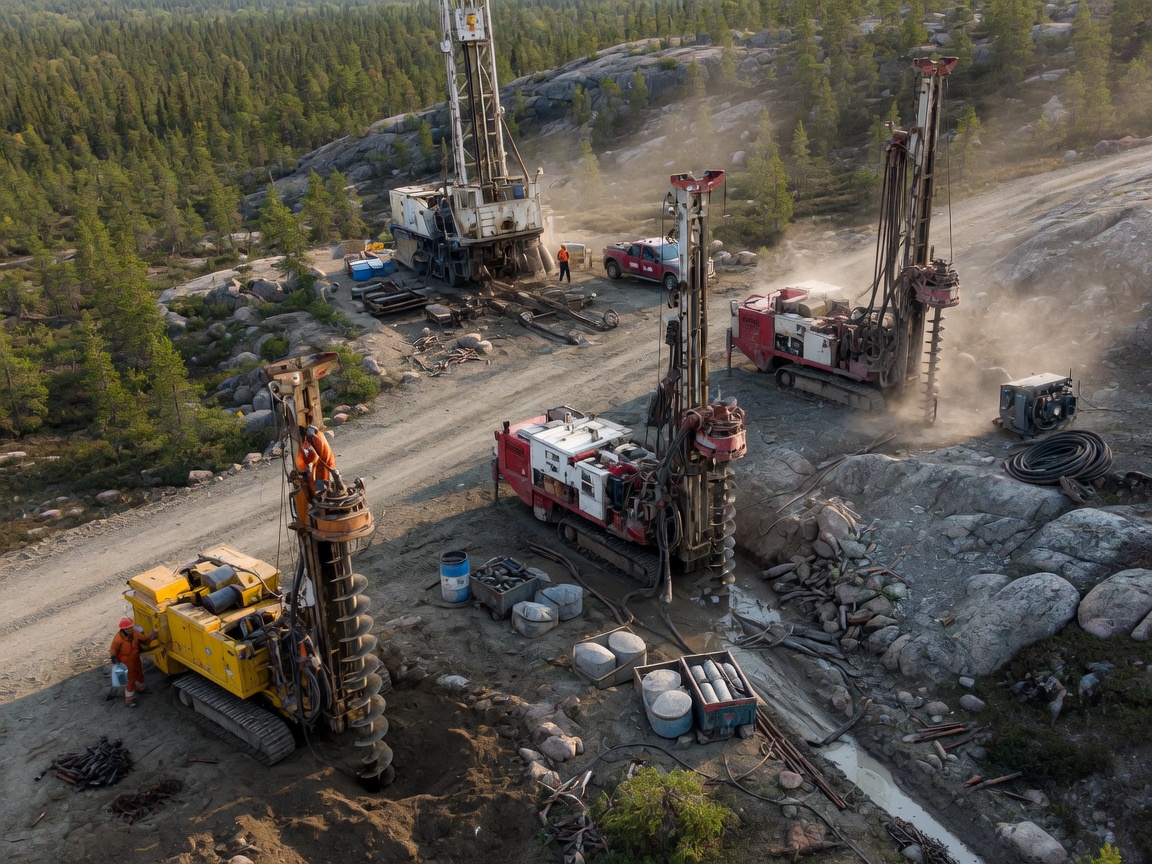
Rotary drilling is the dominant method in oil and gas well drilling worldwide and across Alberta's sedimentary basins. A rotating drill bit grinds through formation rock while drilling fluid (mud) circulates to carry cuttings to surface and maintain borehole pressure. Modern PDC (polycrystalline diamond compact) drill bits paired with rotary steerable systems have dramatically improved penetration rates — in some Prairie basin wells, real-world testing has confirmed rates exceeding 60 metres per hour in softer Cretaceous formations. Just like a high-speed lathe cutting through metal, the system removes material continuously rather than in discrete impacts, making it efficient for deep boreholes.
Directional and horizontal drilling
Directional drilling allows operators to steer the wellbore trajectory away from vertical, reaching subsurface targets that cannot be accessed from directly above. Horizontal drilling — a subset of directional drilling — now accounts for over 50% of new wells drilled globally, and the share is even higher in Canada's Montney and Duvernay plays. This method reduces surface disturbance, lowers per-barrel production costs, and is increasingly favoured under environmental assessment frameworks. The downhole motor and measurement-while-drilling (MWD) tools that enable directional control are sophisticated enough that a single operator can steer a wellbore to within metres of its geological target from thousands of metres away.
Core drilling
Core drilling recovers intact cylindrical rock samples — cores — from the borehole for geological analysis. It is the standard technique for mineral exploration across the Canadian Shield and is also used in geotechnical investigations for dam foundations, tunnels, and large infrastructure. The core barrel surrounds the drill bit and captures the sample without fragmenting it. Actual samples from northern Ontario gold projects, reviewed in recent case studies, demonstrate recoveries above 95% even in fractured rock when diamond-tipped core barrels are used correctly.
Auger drilling
Auger drilling uses a helical screw to advance through soft soils, bringing cuttings to surface via the flighting. It requires no drilling fluid, making it fast, clean, and cost-effective for shallow geotechnical work, environmental sampling, and agricultural applications. Across the Prairies, auger rigs are routinely deployed for soil investigations at depths of 5–30 metres before construction commences. The limitation is obvious — auger drilling cannot penetrate competent rock efficiently, so it is rarely used below the soil profile in Shield terrain.
Percussion and rock drilling
Percussion drilling uses repeated impact — typically from a pneumatic or hydraulic down-the-hole (DTH) hammer — to fracture and advance through hard rock formations. It excels in the competent granite and gneiss of the Canadian Shield, where rotary methods would suffer excessive wear. Rock drilling of this type is standard in mining development, quarrying, and blast-hole preparation. The trade-off is sample quality: percussion methods produce chips rather than core, limiting geological interpretation.
Hydraulic drilling and water well drilling
Hydraulic drilling relies on pressurized fluid to assist the cutting action and maintain borehole integrity. It is closely associated with water well drilling in rural and remote Canadian communities where groundwater access is critical. Of course, there are cases where rotary and hydraulic techniques overlap — modern water well rigs often use rotary-hydraulic hybrid systems that adapt to varying soil and rock conditions encountered in a single borehole.
Drilling equipment and key components
Understanding the equipment behind a drilling operation is essential for procurement, safety planning, and troubleshooting. Every system — from the rig floor to the downhole assembly — has a defined role.
The drill string and drill bit
The drill string transmits rotational force and weight from surface down to the drill bit at the bottom of the borehole. It consists of drill pipe, drill collars (for weight-on-bit), and specialty tools such as stabilizers and jars. The drill bit is the cutting element that contacts formation rock. PDC bits dominate in sedimentary basins; tricone roller bits remain common in harder or more abrasive formations; diamond-impregnated bits are used in core drilling for minerals exploration. Bit selection is arguably the single highest-impact decision in any drilling program — an incorrect choice can double footage costs.
Surface drilling equipment and rigs
The drilling rig provides the mechanical infrastructure: the drawworks lifts and lowers the drill string; the rotary table or top drive rotates it; the mud pumps circulate drilling fluid. For oil and gas operations, rigs are rated by their hook load capacity — typically expressed in tonnes or pounds. Smaller geotechnical and water well rigs are truck-mounted for mobility, a critical feature in Canada's remote northern access corridors where ground conditions limit large rig deployment.
Canadian geology and method selection
Why do so many drilling projects underperform in Canada? Frequently, the answer is a mismatch between method and geology. Canada's geological diversity is exceptional — and each major terrain type demands a different approach.
Canadian Shield: hard rock terrain
The Canadian Shield covers over half of Canada's landmass, spanning Ontario, Quebec, Manitoba, and the territories. It consists predominantly of Precambrian granite, gneiss, and metamorphic rock — among the hardest drilling environments on Earth. Here, percussion rock drilling and diamond core drilling are the methods of choice. PDC bits designed for soft sedimentary rock will fail rapidly in Shield conditions. Experienced drilling contractors working in northern Ontario's gold belt have learned that bit changes are frequent regardless of method, and mobilization planning must account for remote access.
Prairie sedimentary basin
Alberta, Saskatchewan, and southern Manitoba sit atop layered sedimentary sequences — shale, sandstone, limestone, and evaporite formations — that are comparatively soft and predictable. Rotary drilling with PDC bits performs exceptionally well here. The Montney Formation in northeast British Columbia and northwest Alberta is now one of North America's most active drilling plays, with horizontal wells routinely exceeding 3,000 metres of lateral length. Drilling fluid (mud) design is critical in these formations to manage swelling clays and borehole stability.
Permafrost and northern conditions
North of the 60th parallel and in parts of northern Quebec and Labrador, permafrost fundamentally alters drilling engineering. Drilling through permafrost requires careful thermal management — drilling fluids must be formulated to avoid melting the surrounding frozen ground, which would cause borehole collapse. Casing programs must be designed to isolate permafrost zones. In the Northwest Territories and Nunavut, specialized permafrost drilling techniques have been developed by operators working on diamond and base metal projects, where conventional approaches cause irreversible formation damage.
| Terrain type | Primary geology | Recommended method | Key challenge |
|---|---|---|---|
| Canadian Shield | Granite, gneiss, metamorphic | Core drilling, percussion | Rapid bit wear, remote access |
| Prairie sedimentary basin | Shale, sandstone, limestone | Rotary, directional/horizontal | Swelling clays, borehole stability |
| Permafrost (North) | Frozen soil, ice-rich ground | Specialized thermal drilling | Thaw-induced collapse, fluid design |
| Coastal BC / Cordillera | Mixed volcanic, sedimentary | Core drilling, rotary | Steep terrain, seismic risk |
| Prairie / Southern (shallow) | Clay, sand, till | Auger drilling | Groundwater management |
Cost breakdown for drilling projects in Canada
Cost overruns are the single greatest source of frustration for drilling project owners. Understanding what drives the numbers — and where Canadian conditions deviate from global averages — is essential for accurate budgeting.
Per-metre drilling rates and mobilization costs
In southern Alberta and Saskatchewan, rotary drilling for oil and gas wells typically runs CAD $800–$1,800 per metre for shallow to mid-depth wells (under 2,000 m), including rig time and basic services. Deep horizontal wells in the Montney play can see all-in costs of CAD $4–8 million per well. For mineral exploration core drilling in Ontario or Quebec, rates range from CAD $150–$350 per metre for surface drilling, rising sharply with depth. Mobilization costs — moving the rig to site — average CAD $15,000–$60,000 in accessible southern locations but can exceed CAD $250,000 for fly-in northern sites requiring barge or helicopter logistics.
Seasonal pricing differences: north vs. south
Northern Canada operates on a fundamentally different pricing calendar. Winter drilling windows — when frozen ground and ice roads allow heavy equipment access — are the primary operating season for many northern projects. This creates a supply-demand crunch: rig availability tightens between November and March, pushing day rates up by 20–40% compared to shoulder seasons. Conversely, spring breakup (typically March–May depending on latitude) can render access roads impassable, creating forced downtime that project budgets must absorb. In southern Canada, drilling activity tends to peak in spring and fall when agricultural and construction cycles align. The bottom line: scheduling flexibility is a genuine cost management lever in Canadian drilling.
Regulatory requirements by province
No single resource consolidates Canada's provincial drilling regulations — until now. The regulatory landscape is fragmented, and operating across multiple jurisdictions without a clear compliance map is a liability most contractors cannot afford.
Alberta, British Columbia, and Ontario
In Alberta, the Alberta Energy Regulator (AER) governs oil and gas drilling under Directive 059 (Well Drilling and Completion Data Filing Requirements) and Directive 036 (Drilling Blowout Prevention Requirements). All wells require AER approval before spud, and abandonment procedures are strictly regulated under the Liability Management Framework. In British Columbia, the BC Oil and Gas Research and Innovation Society (OGRIS) works alongside the BC Energy Regulator (BCER) — formerly the BC Oil and Gas Commission — which administers drilling approvals under the Petroleum and Natural Gas Act. Well notifications must be filed at least 10 days before drilling commences in most cases. Ontario's Ministry of the Environment, Conservation and Parks (MECP) oversees water well drilling under the Ontario Water Resources Act, requiring licensed well drillers and mandatory well records submission within 30 days of completion. For aggregate and mineral exploration, the Ministry of Mines administers the Mining Act permitting process.
Federal overlay and cross-jurisdictional projects
Projects that cross provincial boundaries or involve federal lands — including First Nations reserves, national parks, or offshore areas — fall under federal oversight. The Canada Energy Regulator (CER) has jurisdiction over interprovincial and offshore pipelines and certain drilling operations. The federal Impact Assessment Act (IAA) triggers a federal review for projects meeting designated thresholds, adding a layer of process that can extend project timelines by 12–24 months. For drilling safety regulations at the occupational level, Canadian operators align with provincial occupational health and safety legislation, though U.S. OSHA frameworks are often referenced as a comparative benchmark.
Environmental and Indigenous consultation obligations
This is the area where Canadian drilling projects most frequently encounter delays — and where the gap between legal obligation and operational practice remains widest.
UNDRIP and the duty to consult
Canada's adoption of the United Nations Declaration on the Rights of Indigenous Peoples (UNDRIP) through federal legislation in 2021 established the principle of free, prior, and informed consent (FPIC) as a standard for projects affecting Indigenous territories. In practice, this means drilling contractors and project proponents must engage potentially affected First Nations, Métis, and Inuit communities before regulatory approval — not after. Meaningful consultation is not a checkbox exercise. Real cases from northern British Columbia demonstrate that inadequate consultation has resulted in project injunctions even after regulatory permits were issued, adding months and tens of millions of dollars in delays.
Environmental assessment and land disturbance requirements
Under the federal Impact Assessment Act, designated projects must undergo an impact assessment that evaluates effects on fish and fish habitat, migratory birds, Indigenous peoples' rights, and federal lands. Provincial environmental assessment processes run in parallel. For drilling projects, specific requirements include spill response plans, drill cuttings disposal protocols, and reclamation security deposits. Waste drilling fluid management is regulated under provincial environmental protection legislation and varies significantly — Alberta's requirements differ from those in Quebec or Nova Scotia. Across all jurisdictions, the trend is toward stricter baseline data requirements and longer post-drilling monitoring periods.
"The duty to consult is not met by simply notifying Indigenous communities — it requires a genuine two-way dialogue that may result in project modifications. Proponents who treat consultation as a procedural hurdle rather than a substantive engagement consistently face the greatest regulatory and legal risk." — Canadian Environmental Law Association, 2025 guidance document
Seasonal and climate considerations for Canadian drilling
Ask any veteran drilling contractor in Canada what they spend most of their planning time on, and the answer is rarely equipment. It is logistics — specifically, the battle against seasons that can shut down entire programs overnight.
Winter drilling windows and northern access
For northern projects above the 55th parallel, winter represents the primary access window. Ice roads on frozen lakes and muskeg allow heavy rig transport that would be impossible in summer. Operators have roughly 8–14 weeks of reliable winter access depending on the year — a window that has been narrowing due to warming temperatures. In the 2025–2026 winter season, several Northwest Territories projects reported shortened ice road seasons by 2–3 weeks compared to historical averages, forcing program compressions and budget overruns. Permafrost thaw is not a future concern; it is an operational reality drilling contractors manage today.
Spring breakup, summer operations, and climate adaptation
Spring breakup creates a hard stop for surface transport to many northern and boreal sites. Projects that are not completed before breakup face either helicopter resupply at enormous cost or suspension until the following winter. Summer operations in northern Canada are possible for fly-in projects, but mobilization costs are substantially higher. On the positive side, longer daylight hours in summer — up to 20+ hours in Yukon — extend daily drilling windows and can partially offset the higher logistics costs. Climate adaptation planning is now a standard component of northern drilling project feasibility studies, something that was considered optional just five years ago.
2026 trends shaping the drilling industry
The drilling industry is evolving faster than at any point in the past two decades. Why are so many operators still relying on 2015-era workflows when the technology gap has widened this dramatically?
Automation, AI, and real-time data analytics
Automated drilling systems that adjust weight-on-bit, rotary speed, and flow rate in real time — without driller intervention — are now commercially deployed on multiple Canadian rigs. AI-driven geological prediction models, trained on offset well data, are reducing non-productive time (NPT) by flagging potential lost circulation zones and formation pressure anomalies before they become well control events. According to recent 2026 data from operators in the Duvernay play, AI-assisted drilling programs have reduced average well costs by 8–14% compared to conventionally managed wells on the same pad. This is not speculative; it is measurable performance data from active Canadian operations.
Low-carbon drilling and energy transition applications
Electric drilling rigs — replacing diesel-powered drawworks and mud pumps with grid-connected or battery-hybrid electric systems — are gaining traction in Alberta, where grid access at well sites is increasingly practical. The carbon reduction is significant: a fully electric rig can eliminate 3,000–5,000 tonnes of CO₂ equivalent per year compared to a diesel-powered equivalent. Beyond oil and gas, geothermal well drilling is experiencing a Canadian renaissance, with projects in British Columbia, Alberta, and the territories advancing under federal clean energy incentive programs. For those seeking detailed production data context, the oil and gas drilling faq from the U.S. Energy Information Administration provides useful comparative benchmarks against North American industry norms.
Evolving equipment standards and market outlook
The 2026 drilling equipment market in Canada reflects consolidated demand: fewer but larger drilling contractors now operate fleets of standardized, digitally instrumented rigs. This standardization reduces training costs and spare parts inventory but raises barriers to entry for smaller operators. Drill bit technology continues to advance rapidly — hybrid PDC-roller designs now handle mixed hard-soft formations that previously required multiple bit runs, reducing trip time and well costs. The global market trajectory supports continued growth, and Canada's dual role as both a hydrocarbon producer and an emerging critical minerals supplier means domestic drilling demand will remain robust through the decade.
Frequently asked questions
Common questions answered
Q: What is the most common drilling method used in Canada?
A: Rotary drilling is the most widely used method in Canada, particularly for oil and gas well drilling in Alberta and Saskatchewan. For mineral exploration on the Canadian Shield, diamond core drilling is the industry standard. Auger drilling is common for shallow geotechnical investigations across all provinces.
Q: How much does a drilling project cost in Canada?
A: Costs vary widely. Oil and gas horizontal wells in Alberta range from CAD $4–8 million. Mineral exploration core drilling runs CAD $150–$350 per metre in accessible locations. Mobilization alone can reach CAD $250,000+ for northern fly-in sites. Seasonal timing and terrain type are the two biggest cost variables.
Q: Do drilling projects in Canada require Indigenous consultation?
A: Yes. Under Canada's federal legislation implementing UNDRIP and the constitutional duty to consult, drilling projects affecting Indigenous territories require meaningful consultation — and in many cases, consent — from affected First Nations, Métis, and Inuit communities before regulatory permits are issued or work begins.
Q: What regulations govern oil and gas drilling in Alberta?
A: The Alberta Energy Regulator (AER) is the primary regulator, administering approvals under Directive 059 and Directive 036 among others. All oil and gas wells require AER approval prior to drilling. Abandonment, reclamation, and liability management are also governed under AER rules.
Q: How is permafrost affecting drilling operations in northern Canada?
A: Permafrost thaw is shortening winter access windows by 2–3 weeks per season in some northern regions, compressing drilling programs and increasing costs. Operators must also design casing programs and drilling fluid systems specifically to prevent heat transfer into frozen formations, which can cause catastrophic borehole collapse if mismanaged.
In summary, drilling in Canada is a technically demanding, heavily regulated, and geologically diverse discipline. From the hard rock terrain of the Canadian Shield to the sedimentary basins of the Prairies and the frozen ground of the North, selecting the right drilling method, budgeting accurately, meeting provincial and federal regulatory requirements, and respecting Indigenous consultation obligations are all prerequisites for project success. The 2026 industry is evolving rapidly toward automation and lower-carbon operations — and the operators who understand both the engineering fundamentals and the Canadian regulatory landscape will be best positioned to compete.
Request a Quote
* Please provide your contact information to receive a product quote or a sample.
Related News


ALL PRODUCTS
Subscribe To Our Newsletter
By clicking Register, you acknowledge that you have read and accepted our Terms and Conditions.
E-mail
info@changlutools.com
Tel
86 539 8392999
Add:No.19 Feng'an Road, Fenghuangling Subdistrict, Yihe New District, Linyi City, Shandong Province, P.R.China
Forgot your password
Please select one of the following methods to complete the authentication


