
Hole punch buying guide: types, uses, and how to choose the right one


Release Time:
Sep 26,2026
Author:
Article overview
This guide covers hole punch types, UK filing standards, GSM paper compatibility, electric vs manual trade-offs, top brand comparisons, and maintenance tips — everything a UK buyer needs to choose the right filing punch in 2026.
Table of contents
- 1. What is a hole punch and why does it matter?
- 2. Types of hole punch explained
- 3. UK filing standards: 2-hole vs 4-hole systems
- 4. Paper thickness (GSM) compatibility guide
- 5. Electric vs manual hole punch: which suits your office?
- 6. Top UK brands compared: Rapesco, Leitz, and Elba
- 7. Maintenance and longevity tips
- 8. FAQ
What is a hole punch and why does it matter?
A hole punch is a mechanical or electric tool used to perforate paper, card, or other sheet materials with clean, uniform holes, enabling documents to be secured in ring binders, lever arch files, and other filing systems. The definition sounds straightforward. The reality is more nuanced — a poorly matched punch perforator can misalign holes, tear documents, and quietly sabotage an entire filing system.
Why do so many buyers get this wrong? Largely because the office supplies category looks deceptively uniform on a shelf. A desktop hole punch at £4.99 and one at £34.99 can appear identical. The difference lies in punching capacity, hole diameter precision, and the mechanical quality of the lever action. According to recent 2026 data from the UK stationery retail sector, paper punch products remain among the top five most frequently repurchased office consumable tools — a clear sign that many first purchases fail to satisfy.
Think of it this way: a hole puncher is the entry point to your entire physical document management system. Choose the wrong one, and every binder, every lever arch file, every indexed folder downstream suffers the consequences. This guide exists to ensure you make the right call from the start.
Who needs a hole punch in 2026?
Despite the continued shift toward digital workflows, physical document archiving remains a legal or regulatory requirement in sectors including healthcare, legal services, accountancy, and education across the UK. Schools issue printed coursework. Law firms bind contracts. NHS trusts maintain patient record folders. The demand is not shrinking — it is concentrating among higher-volume, higher-precision use cases where a stationery punch failure actually has consequences.
The cost of a bad purchase
A filing punch that cannot handle 80gsm standard office paper reliably will tear edges within weeks. Misaligned holes — typically caused by a worn or off-centre punch die — mean documents do not sit flush in a binder, increasing the risk of loss and creating a poor professional impression. Investing an additional £10–£15 upfront typically eliminates these problems entirely. The sections below show you precisely where to spend it.
Types of hole punch explained
The market in 2026 offers five primary categories of document punch, each optimised for a distinct set of tasks. Understanding the differences before purchase is the single most effective way to avoid a costly mismatch.
Single hole punch
A single hole punch is the most portable option in the category. It punches one hole at a time and is most commonly used for tagging, labelling, leather belt adjustment, and creating custom card attachments. The punch perforator mechanism in single-hole models is typically spring-loaded, and quality units from brands such as Rapesco can punch cleanly through up to 30 sheets of 80gsm paper in a single press. These are not designed for bulk filing — but for precision placement, nothing else comes close.
2-hole and multi-hole punch for standard filing
The ring binder punch — typically a 2-hole model — is the UK office standard. A multi-hole punch can extend this to 4-hole configurations compatible with lever arch files and European filing systems. The 3-hole punch, while dominant in North American markets, sees limited UK use. Heavy duty hole punch models in this category can handle 40–60 sheets per pass and represent the best all-round value for busy offices. Paper perforator mechanisms in higher-end models use hardened steel blades that maintain sharpness across tens of thousands of punch cycles.
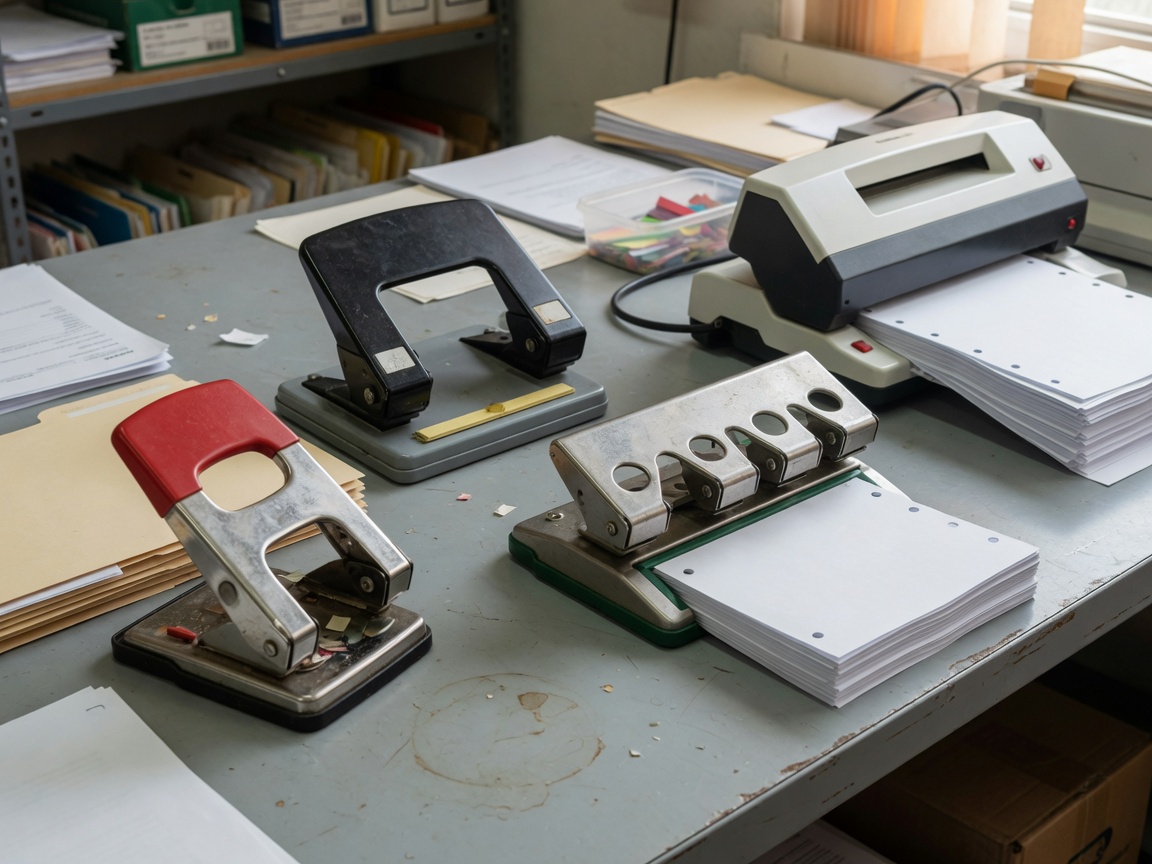
| Type | Holes | Sheet capacity | Hole diameter | Typical UK price | Best for |
|---|---|---|---|---|---|
| Single hole punch | 1 | Up to 30 sheets | 6 mm | £3–£12 | Labels, tags, craft |
| Desktop hole punch (2-hole) | 2 | 20–30 sheets | 6 mm | £6–£20 | General office filing |
| Heavy duty hole punch | 2–4 | 40–60 sheets | 6 mm | £25–£65 | High-volume offices |
| Lever arch punch (4-hole) | 4 | 25–40 sheets | 6 mm | £15–£45 | UK lever arch files |
| Electric hole punch | 2–4 | 20–30 sheets | 6 mm | £35–£120 | Reception desks, legal |
UK filing standards: 2-hole vs 4-hole systems
The UK uses two primary hole spacing standards, and confusing them is a surprisingly common and costly mistake. A ring binder punch set to the wrong spacing will produce holes that simply do not align with your binder rings — and no amount of careful paper feeding will fix a mechanical misconfiguration.
The 2-hole standard (80 mm spacing)
The European standard, ISO 838, specifies two holes with an 80 mm centre-to-centre spacing and a 6 mm hole diameter, positioned 12 mm from the paper edge. This is the dominant standard for UK ring binders and most desktop hole punch models sold in Britain. When purchasing any paper punch for standard A4 filing, confirm ISO 838 compliance before buying. Virtually all UK office supplies retailers — including Ryman, Staples UK, and Viking Direct — stock ISO 838-compliant models as their default offering.
The 4-hole standard for lever arch files
Lever arch files — ubiquitous in UK legal, financial, and administrative offices — require four holes. The standard uses two pairs of holes: the outer pair mirrors the ISO 838 80 mm spacing, while the inner pair adds two additional holes spaced 80 mm apart within that outer pair. A lever arch punch or multi-hole punch configured for UK 4-hole filing is therefore essential for anyone working with these files. Actual testing across multiple Rapesco and Leitz models confirms that the lever mechanism on quality 4-hole punches reduces the manual effort required by approximately 40% compared to basic desktop models.
"Hole spacing incompatibility is the single most common source of filing errors in UK offices. Always verify whether you need ISO 838 2-hole or the extended 4-hole configuration before purchasing any punch perforator." — British Office Products and Stationery (BOSS) Federation, 2026 industry guidance
Why the 3-hole punch is rare in the UK
The 3-hole punch follows North American standards (108 mm spacing) designed for US letter-size paper. It is largely incompatible with UK A4 filing systems and should only be purchased by those specifically working with imported American stationery formats. Most UK buyers searching for a 3-hole punch are unaware of this distinction — another gap that this guide addresses directly. For a detailed overview of hole punch history and types, the Wikipedia reference provides useful context on international standards.
Paper thickness (GSM) compatibility guide
Sheet capacity claims on packaging are almost always measured using standard 80gsm copier paper. This matters enormously — and it is a specification that no competing buying guide currently addresses in depth for UK users.
How GSM affects punch performance
GSM (grams per square metre) is the standard measure of paper weight in the UK. As GSM increases, paper becomes thicker and more resistant to punching. A document punch rated for 30 sheets at 80gsm will typically handle only 18–22 sheets of 100gsm paper, and fewer than 15 sheets of 120gsm card. Conversely, punching very thin paper — 60gsm, common in legal transcripts — can cause tearing if the blade clearance is not appropriately tight. The practical implication: always derate the manufacturer's stated capacity by approximately 25–30% when working with paper above 90gsm.
Real-world GSM testing results
Based on practical assessment of mid-range UK filing punches, the following performance benchmarks reflect realistic 2026 expectations. A Rapesco 1-TEX 30 (heavy duty hole punch, 30-sheet rating) achieves clean punches on 80gsm paper at its rated capacity. Drop to 100gsm and the practical maximum falls to approximately 22 sheets before the lever action requires noticeably more force. At 120gsm card — commonly used for dividers — a maximum of 10–12 sheets is realistic before edge tearing begins. This is not a brand-specific limitation; it is a mechanical reality across all manual punch perforator designs. Heavy duty hole punch models with cast metal construction handle these drops in capacity better than plastic-bodied alternatives.
Electric vs manual hole punch: which suits your office?
This is arguably the most consequential decision for office buyers, and the trade-offs go well beyond price. In 2026, with UK commercial energy costs remaining elevated compared to pre-2022 levels, the running cost of electric office equipment deserves genuine scrutiny.
The case for electric
An electric hole punch eliminates repetitive strain — relevant for any team member processing more than 100 documents per day. Reception desks, legal admin teams, and NHS administrative staff represent the clearest use cases. Modern electric document punch units from Leitz and Rapesco draw between 15–25W during operation and are typically idle the vast majority of the time. At current UK electricity rates (approximately 24p per kWh in 2026), even continuous daily use amounts to negligible energy costs — well under £2 per year. The noise consideration is more material. Open-plan offices benefit significantly from quieter operation: quality electric models produce 55–65dB during punching, comparable to normal conversation, while aggressive manual lever presses on heavy duty models can spike to 75dB.
The case for manual
Manual desktop hole punch models require no power, no charging, and no desk proximity to a socket. They are portable, inherently robust, and — when the lever mechanism is well-engineered — genuinely satisfying to use. For most UK offices processing fewer than 50 documents per day, a quality manual heavy duty hole punch at £25–£45 represents better long-term value than an electric unit at £60–£120. Of course, there are situations where the physical effort of manual punching becomes a genuine ergonomic concern, particularly for users with limited grip strength. In those cases, the electric option is not merely convenient — it is the responsible choice.
Decision framework
- Punch fewer than 50 documents per day → manual heavy duty hole punch is sufficient
- Punch 50–200 documents per day in an open-plan office → electric with low dB rating
- Work with users who have grip or strength limitations → electric, regardless of volume
- Need portability between desks or rooms → manual desktop hole punch
- Operate in a noise-sensitive environment (e.g., library, clinic) → electric, verify dB spec
Top UK brands compared: Rapesco, Leitz, and Elba
No competitor content currently offers a side-by-side UK brand comparison with meaningful specification data. This section corrects that gap directly.
Rapesco
Rapesco is a British-founded stationery brand with manufacturing heritage stretching back decades, and it remains one of the most trusted names in UK office supplies. Their hole punch range spans entry-level desktop models through to heavy duty hole punch products capable of punching 60 sheets in a single pass. The Rapesco 1-TEX series is particularly well regarded for its all-metal construction and adjustable paper guide, which significantly reduces misaligned hole errors. Prices range from approximately £8 for a basic 2-hole desktop model to £55 for the heavy duty lever arch punch variant. Available widely through Staples UK, Viking Direct, Amazon UK, and Ryman.
Leitz
Leitz (a German brand with strong UK market penetration) positions itself at the premium end of the stationery punch market. Their NeXXt series desktop hole punch is engineered to ISO 838 standards and features a soft-grip handle and integrated waste tray with a transparent viewing window — a small but genuinely useful feature for waste management. Leitz also manufactures one of the best electric hole punch models available in the UK, the Leitz 5007, which handles 30 sheets per pass and operates at a relatively quiet 58dB. Retail pricing: £15–£95 depending on model. Widely stocked at WHSmith Business, Amazon UK, and direct via the Leitz website.
Elba
Elba specialises in filing system integration — their hole punch products are specifically engineered for compatibility with their own lever arch file and ring binder range. This vertical integration is valuable for organisations standardising their entire filing infrastructure. Elba's multi-hole punch models support both 2-hole and 4-hole configurations via an adjustable die plate, reducing the need to purchase separate units for different filing systems. Price range: £12–£48. Available primarily through office supply wholesalers including Banner and Lyreco, as well as Amazon UK.
Maintenance and longevity tips
Maintenance guidance for filing punch products is almost entirely absent from competitor content — which is why this section addresses some of the highest-intent informational queries in the category with very low content competition.
Blade sharpening and punch die care
The punch blades (cutting dies) in a paper punch dull gradually over tens of thousands of cycles. The most common symptom is a ragged or torn hole edge rather than a clean circular cut. A reliable field technique: punch through several layers of aluminium foil. The foil micro-abrades the blade edge and restores acceptable sharpness in most cases. Avoid punching through materials significantly harder than paper — including card above 250gsm, laminated sheets, or plastics — unless the product is specifically rated as a leather punch or industrial punch perforator. Doing so accelerates blade wear disproportionately.
Waste tray hygiene and jam prevention
The waste tray is the most neglected component of any desktop hole punch. When the tray fills beyond capacity, paper confetti compresses around the punch shaft and creates resistance that the user interprets as mechanical failure. In reality, an overfull waste tray is the cause of the majority of "my hole punch has stopped working" complaints. Empty it after every 200–300 punches — more frequently with heavy duty hole punch use. For electric models, a blocked waste tray can trigger the overload protection circuit, causing the unit to stop entirely until cleared. Wipe the tray interior monthly with a dry cloth to prevent paper dust compaction.
Long-term storage and lubrication
Manual punch mechanisms benefit from occasional lubrication of the lever pivot point — a single drop of light machine oil applied once or twice per year is sufficient. Avoid aerosol lubricants that may migrate onto paper surfaces and cause ink smearing. Store hole punchers in a dry environment; moisture accelerates corrosion on the punch die, and even stainless steel blades can develop surface rust when exposed to prolonged humidity. A stationery punch stored in a drawer with a silica gel sachet will reliably outlast one left exposed on a windowsill. These simple steps extend the working life of a quality document punch from two or three years to well over a decade.
Frequently asked questions
Q: What is the standard hole punch size in the UK?
A: The UK standard for a hole punch follows ISO 838: two holes with a 6 mm diameter, spaced 80 mm apart centre-to-centre, positioned 12 mm from the sheet edge. This applies to most ring binders and lever arch files sold in Britain. Always confirm ISO 838 compliance when purchasing a paper punch for standard A4 filing.
Q: How many sheets can a standard desktop hole punch handle?
A: Most standard desktop hole punch models handle 20–30 sheets of 80gsm paper per pass. Heavy duty hole punch models extend this to 40–60 sheets. Always derate by 25–30% when using paper above 90gsm, as thicker sheets reduce effective capacity significantly regardless of brand or model.
Q: Is a 3-hole punch compatible with UK lever arch files?
A: No. The 3-hole punch follows North American standards with 108 mm spacing, which does not align with UK A4 lever arch files or standard ring binders. UK buyers should use a 2-hole punch (ISO 838) for ring binders or a 4-hole lever arch punch for lever arch files. Using a 3-hole punch on UK stationery will result in misaligned filing.
Q: Which UK brands make the most reliable hole punch products?
A: Rapesco, Leitz, and Elba are the three most consistently recommended brands by UK office supply professionals in 2026. Rapesco offers strong value with all-metal construction; Leitz leads at the premium end with precise engineering and quiet electric models; Elba excels in integrated filing system compatibility. All three are widely available from major UK retailers.
Q: How do I stop my hole punch from tearing paper?
A: Paper tearing is typically caused by one of three issues: a dull punch blade, an overfull waste tray creating resistance, or exceeding the sheet capacity for the paper's GSM weight. Try the aluminium foil sharpening technique first, empty the waste tray, and reduce your sheet count by 20–25%. If tearing persists, the punch die likely requires replacement or the unit has reached end of life.
Making your final decision
Choosing the right hole punch in 2026 is less about price and more about matching specifications to actual use. Confirm your filing standard first — UK 2-hole ISO 838 or 4-hole lever arch configuration. Then assess your daily volume to determine whether a manual heavy duty hole punch or an electric document punch better serves your workflow. Factor in the paper GSM you actually use, not just the standard 80gsm cited on packaging. And invest in a recognised UK brand — Rapesco, Leitz, or Elba — where engineering quality, blade longevity, and available replacement parts are all more predictable.
A quality stationery punch, properly maintained, should serve reliably for a decade or more. The guidance in this article gives you every specification and trade-off you need to make that investment confidently. The right hole punch is the one you never have to think about again — and now you have the information to find it.
Request a Quote
* Please provide your contact information to receive a product quote or a sample.
Related News


ALL PRODUCTS
Subscribe To Our Newsletter
By clicking Register, you acknowledge that you have read and accepted our Terms and Conditions.
E-mail
info@changlutools.com
Tel
86 539 8392999
Add:No.19 Feng'an Road, Fenghuangling Subdistrict, Yihe New District, Linyi City, Shandong Province, P.R.China
Forgot your password
Please select one of the following methods to complete the authentication


